



THF at MIPIM
Table of content
- THF at MIPIM
- THF – A Long-term Urban Transformation under Public Ownership
- One of Europe’s largest listed building complexes
- A globally recognized historical reference
- Operational Status
- The THF Development Concept as a Strategic Framework
- Institutional Governance and Professional Oversight
- Operational Framework 2045 - Structured Process, Long-term Stability, clearly defined projects
- Stay connected
- Contact for Strategic Inquiries
THF – A Long-term Urban Transformation under Public Ownership
The former Tempelhof airport (THF) is a city within the city. With approximately 300,000 m² of gross floor area, it represents one of Germany’s most significant and complex urban transformation projects. Tempelhof Projekt GmbH is implementing an integrated, cross-disciplinary governance framework to secure this historically and politically sensitive asset. Responsibility is exercised through a phased, robust development process for long-term development under public ownership.
One of Europe’s largest listed building complexes
- Approx. 300,000 m² of Gross Floor Area
- 1.2 kilometers of continuous building length
- Several thousand individual rooms and operational units, forming a highly differentiated spatial system
- Approx. 55.5 hectares total site area
- Listed heritage site of national significance under monument protection
A globally recognized historical reference
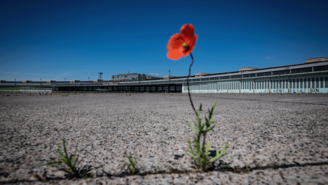
THF is a culturally and politically sensitive site of high historical significance and a major monument of 20th-century architecture, subject to a binding heritage and conservation framework. It directly borders Tempelhof Field — one of Europe’s largest inner-city open spaces, located on the former runways of the airport. This immediate adjacency creates a spatial, historical and social relationship between monument, landscape and aviation history. Preserving the architectural fabric while strengthening the interface between the protected structure and its former airfield is a core objective of the transformation process.
Operational Status
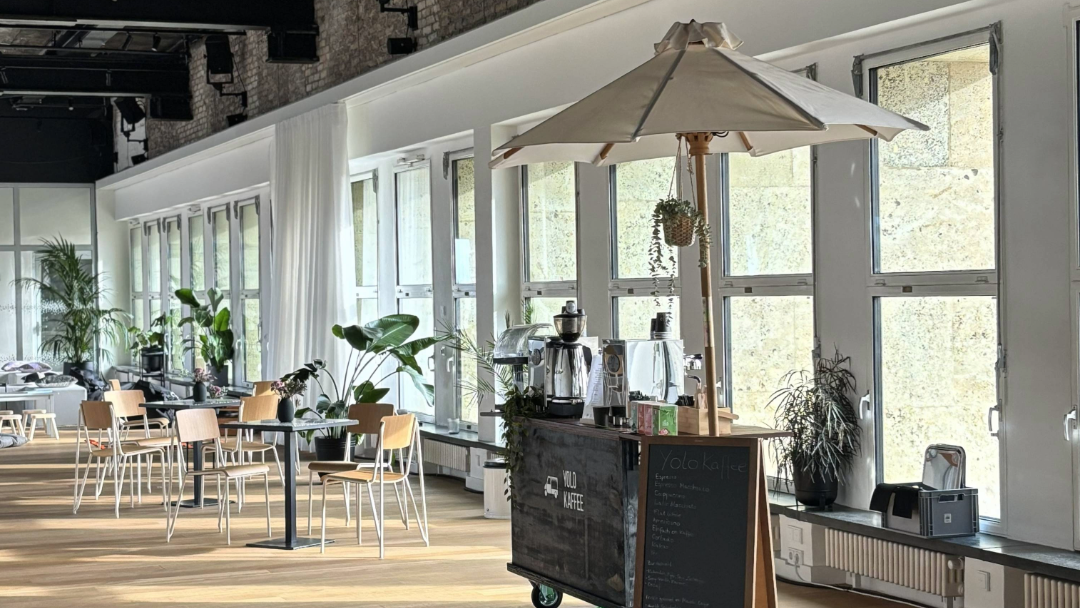
Unlike greenfield sites, Tempelhof is an operational building in continuous use. Transformation takes place during full operating conditions and is characterized by a high level of ongoing activity across cultural, civic, and commercial functions:
- Approximately 400,000 visitors per year through public programs, events and location-based uses
- Around 150 events annually, ranging from culture and exhibition formats to large-scale productions
- More than 2,000 guided tours per year, including thematic and educational formats
- Film and media productions taking place on a regular, ongoing basis
- Over 40 permanent tenants occupying approximately 80,000 m² of floor space
- A continuously operated Visitor Center and publicly accessible THF TOWER
- Humanitarian and civic uses embedded into the site
- Ongoing construction, renovation and maintenance works across the building complex
This level of permanent activity requires a carefully phased, tightly sequenced, and clearly regulated approach to modernization and long-term development.
The THF Development Concept as a Strategic Framework
Our development concept provides the strategic foundation for the long-term transformation of THF. It defines objectives, priorities and guiding principles across spatial, functional and temporal dimensions, creating a shared frame of reference for all future decisions.
Why THF requires a conceptual approach
THF is a large-scale, listed and continuously operated site with highly diverse uses and stakeholders. Its transformation affects not only individual buildings, but the entire urban fabric, governance structures and modes of operation. This level of complexity requires early and continuous strategic alignment in conjunction with design decisions.
Scope and content
The development concept integrates urban structure, heritage conservation, sustainability, mobility, programmatic uses and economic viability. It works across different planning horizons – from short-term measures to long-term development paths – and links city-scale challenges with architectural depth and feasibility.
Process and methodology
The concept is developed through an interdisciplinary, step-by-step process supported by expert studies and workshops. Knowledge is built cumulatively, options are tested and priorities are refined. This ensures a robust and transparent basis for subsequent planning phases.
From orientation to action
The development concept does not produce finished designs. Instead, it creates clarity and decision security, enabling targeted architectural commissions, pilot projects and phased implementation. It defines the “why” and “what” – architecture and engineering respond with the “how”.
Institutional Governance and Professional Oversight
The transformation is steered by Tempelhof Projekt GmbH and supported by an institutionally embedded panel of independent experts. This governance structure ensures that all steps are professionally validated, administratively secured and publicly accountable.
Internal Management
Edith Wunsch
Head of Real Estate Development
Tempelhof Projekt GmbH
Team: Project Development
Selected Expert Panel
- Sustainability Strategy: KPMG (Francesca Galeazzi, Eric Pawelczyk)
- Urban Micro-Climate & Ecology: GEO-NET Umweltconsulting (Janine Könitz / Peter Trute)
- Spatial Connectivity Analysis: Space Syntax (Anna Rose)
- Mobility & Urban Connectivity: Good Mobility Council (Ingo Kucz / Christian Scheler)
- Heritage & Building History: Büro West (Georg Wasmuth / Hannah Münzer)
- Heritage Context - Dissonant Heritage - Transformation:
Prof. Ingrid Scheurmann
Prof. Dr. Harald Bodenschatz
- Early Activation Strategy and Use Concepts: Baubüro InSitu & Denkstatt Sàrl (Eric Honegger)
- Place-Making Strategies: Think Softer Planning AB (David Sim / Nina Otrén)
- Urban and Spatial Conceptual Approaches:
MVRDV ( Winy Maas, Christine Sohar, Sven Thorissen)
City Förster ( Prof. Dr.-Ing. Verena Brehm)
SMAQ (Sabine Müller)
- Landscape Concepts & Heritage: Robin Winogrond
- Project Development Expertise with Listed Buildings and large-scale Urban Brownfield Sites, incl. Re-Use Concepts:
Prof. Hans-Peter Noll (formerly CEO Zeche Zollverein UNESCO World Heritage Site)
GCD & NLND (Martin Eyerer / Felix Richter)
Thomas Bestgen (CEO UTB-Gruppe & Board of Directors GLS Bank)
- Building Adaptation Concepts:
Brenne Architekten (Winfried Brenne & Fabian Brenne)
Weberbrunner Architekten (Elise Pischetsrieder)
Transsolar Klima Engineering (Helmut Meyer)
- Building History Archival Research: Dr.-Ing. Elke Dittrich
- Process Coordination: Urban catalyst (Prof. Klaus Overmeyer)
Operational Framework 2045 - Structured Process, Long-term Stability, clearly defined projects
Transformation at this scale is measured in decades. Development is guided by clearly defined and verified milestones to ensure structural integrity, operational continuity and public accountability.
- 2025–2027: Completion of the Development Concept; prioritization of key focus areas and technical measures, including climate resilience studies in central open spaces, action maps, and a phased implementation plan as core tools for strategic redevelopment.
- 2028–2035: Step-by-step adaptationand implementation of selected short- and medium-term measures; gradual expansion of public accessibility and programmatic uses.
- 2045: Full implementation of key transformation projects within a fully integrated, long-term operational framework for the entire site.
Stay connected
This page serves as the official project information and update channel. Progress is systematically documented and independently verified through periodic publications.
Updates on results and upcoming implementation steps will be presented at MIPIM 2027. We look forward to continuing the dialogue there.
Contact for Strategic Inquiries
Edith Wunsch
Head of Real Estate Development
Tempelhof Projekt GmbH
entwicklung@thf-berlin.de
